Astronomy Dictionary
Education
4.8(95)
5,000+
Screenshots





About this app
Explore the cosmos with Astronomy Dictionary, your comprehensive offline guide to astronomical terms, celestial concepts, and space science terminology. This free astronomy reference app provides clear definitions, explanations, and insights into thousands of terms related to stars, planets, galaxies, cosmology, and the vast universe that surrounds us—perfect for students, educators, amateur astronomers, space enthusiasts, and anyone fascinated by the night sky.
🌌 Why Choose Astronomy Dictionary?
Astronomy is the study of celestial objects and phenomena—a science that uses mathematics, physics, and chemistry to explain the origin and evolution of everything beyond Earth's atmosphere. From planets and moons to stars and galaxies, from black holes to the cosmic microwave background radiation, astronomy encompasses countless specialized terms that can be challenging to understand without proper definitions.
Astronomy Dictionary makes the universe accessible to everyone by providing clear, concise explanations of astronomical terminology in plain language. Whether you're a student studying astrophysics, an amateur astronomer observing the night sky, a science teacher preparing lessons, or simply someone who looks up in wonder, this comprehensive astronomy glossary helps you understand the language of the cosmos.
🔭 Comprehensive Astronomy Coverage
Celestial Objects:
Stars and stellar classification
Planets and planetary systems
Moons and satellites
Asteroids and meteorites
Comets and their composition
Nebulae and star-forming regions
Galaxies and galaxy types
Star clusters
Pulsars and neutron stars
Black holes and event horizons
Astronomical Phenomena:
Supernovae and stellar explosions
Gamma-ray bursts
Quasars and active galaxies
Solar and lunar eclipses
Auroras and atmospheric phenomena
Meteor showers
Planetary transits
Gravitational lensing
Red shifts and blue shifts
Cosmic inflation
Cosmology & Universe:
Big Bang theory
Dark matter and dark energy
Cosmic microwave background
Universe expansion
Spacetime and relativity
Multiverse theories
Cosmic evolution
Structure formation
Observable universe
Ultimate fate of universe
Observational Astronomy:
Telescopes and types
Spectroscopy techniques
Photometry methods
Radio astronomy
Infrared astronomy
X-ray astronomy
Astrometry measurements
Light curves
Magnitude scales
Coordinates systems
✨ Powerful Dictionary Features
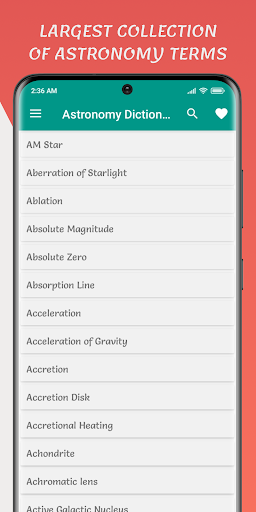
📖 Thousands of Terms - Comprehensive astronomy vocabulary
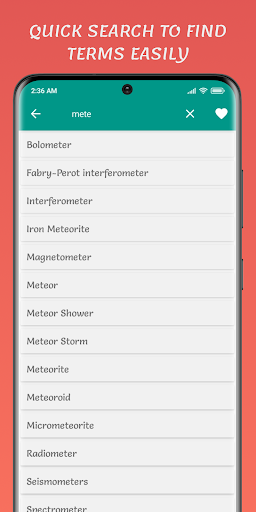
🔍 Smart Search - Find definitions instantly
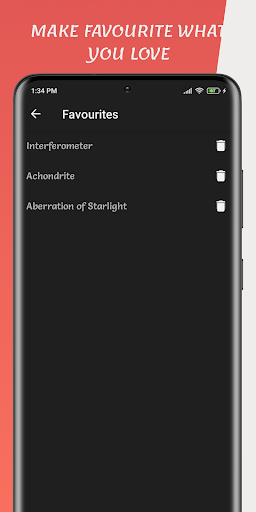
❤️ Favorites - Bookmark important terms
📋 Copy Definitions - Share knowledge easily
📴 100% Offline - No internet required
🎨 Clean Layout - Easy-to-read definitions
⚡ Lightweight - Small app size
🌟 Alphabetical Order - Logical organization
📚 Clear Explanations - Plain language definitions
🎯 Quick Access - Fast term lookup
💡 Educational - Perfect for learning
🎓 Academic Quality - Scientifically accurate
🌌 Regular Updates - New terms added
🎁 Completely Free - No premium features
🔬 Scientific Accuracy - Verified information
🌟 Astronomy Branches Covered
Astrophysics:
Terms related to the physical properties and processes of celestial objects and phenomena.
Planetary Science:
Definitions covering planets, moons, and planetary systems within and beyond our solar system.
Stellar Astronomy:
Terminology about star formation, evolution, classification, and stellar phenomena.
Galactic Astronomy:
Terms describing galaxies, galaxy clusters, and large-scale cosmic structures.
Cosmology:
Definitions related to the origin, evolution, and ultimate fate of the universe itself.
Astrobiology:
Terms concerning the search for life beyond Earth and habitability conditions.
Observational Astronomy:
Terminology related to observation methods, instruments, and measurement techniques.
Astrometry:
Definitions covering precise measurements of celestial positions and movements.
Radio Astronomy:
Terms specific to studying universe through radio wavelengths and radio telescopes.
Solar Astronomy:
Specialized terminology about our Sun, solar activity, and solar-terrestrial relations.
🎯 Perfect For
✅ Astronomy students at all levels
✅ Amateur astronomers and stargazers
✅ Science teachers and educators
✅ Space enthusiasts and hobbyists
✅ Planetarium visitors
✅ Science communicators
✅ Astrophotographers
✅ Science fiction fans
✅ Telescope users
✅ Space news readers
✅ Physics students
✅ Observatory visitors
✅ Anyone curious about space
✅ Science quiz participants
💡 How This Dictionary Helps
Academic Support:
Essential reference for astronomy courses, assignments, and exam preparation at high school and university levels.
Observation Enhancement:
Understand technical terms encountered in star charts, astronomy guides, and observation planning tools.
News Comprehension:
Grasp space news and astronomical discoveries by understanding the specialized terminology used.
Teaching Tool:
Help educators explain astronomical concepts with accurate definitions and clear explanations.
Self-Directed Learning:
Enable independent study of astronomy with reliable definitions always at your fingertips.
Curiosity Satisfaction:
Quickly look up unfamiliar terms encountered while reading astronomy books or watching space documentaries.
Communication:
Speak confidently about astronomy using correct terminology and understanding concepts properly.
📚 Sample Astronomy Terms
Astronomical Unit (AU):
The average distance from Earth to the Sun, approximately 150 million kilometers, used as a standard unit for measuring distances within solar systems.
Redshift:
The phenomenon where light from distant objects is shifted toward longer (redder) wavelengths due to the universe's expansion or relative motion.
Nebula:
A giant cloud of gas and dust in space, some of which are star-forming regions while others are remnants of dead stars.
Light-Year:
The distance light travels in one year, approximately 9.46 trillion kilometers, used to measure vast cosmic distances.
Exoplanet:
A planet that orbits a star outside our solar system, also called extrasolar planet.
Event Horizon:
The boundary around a black hole beyond which nothing, not even light, can escape the gravitational pull.
Parsec:
A unit of astronomical distance equal to about 3.26 light-years or 31 trillion kilometers, used for measuring distances to stars and galaxies.
🌌 Educational Value
For Students:
Perfect companion for astronomy courses, providing quick reference to technical terms encountered in textbooks and lectures.
For Teachers:
Reliable resource for preparing lessons, creating materials, and answering student questions about astronomical terminology.
For Amateur Astronomers:
Essential tool for understanding star charts, astronomy magazines, and technical discussions in astronomy clubs.
For General Public:
Accessible introduction to astronomy vocabulary that makes space science understandable and engaging.
🎁 Completely Free Features
Complete astronomy terminology database
All definitions unlocked
Unlimited searches and lookups
Favorites collection
Copy and share definitions
100% offline access
No registration required
No subscription fees
No locked premium content
Regular free updates
Minimal advertising
Fast, responsive performance
🔬 Scientific Accuracy
Every definition in this astronomy dictionary is:
Scientifically Verified:
Based on established astronomical knowledge and current scientific understanding.
Clearly Explained:
Written in accessible language that balances accuracy with comprehensibility.
Up-to-Date:
Regularly updated to reflect current terminology and recent discoveries in astronomy.
Educational:
Designed to build understanding progressively, from basic to advanced concepts.
Reliable:
Suitable for academic use, teaching, and serious astronomical study.
🌠 How to Use This App
Quick Lookup:
Search for specific terms you encounter in books, articles, or observations.
Systematic Learning:
Browse alphabetically to systematically build your astronomical vocabulary.
Favorite Building:
Mark important terms for quick reference and focused study.
Reference Material:
Use definitions as starting points for deeper research into astronomical topics.
Teaching Aid:
Show students clear definitions during lessons or group observations.
Study Tool:
Review terms before exams or refresh knowledge before observatory visits.
🌟 Astronomy: An Ancient Science
Astronomy is one of humanity's oldest natural sciences. Early civilizations including the Babylonians, Greeks, Indians, Egyptians, Chinese, Maya, and indigenous peoples of the Americas made methodical observations of the night sky. This dictionary preserves and explains the terminology that has evolved through millennia of cosmic observation.
Today, professional astronomy is often synonymous with astrophysics, divided into observational and theoretical branches that complement each other. Observational astronomy focuses on acquiring data from celestial observations, while theoretical astronomy develops models to explain these observations and phenomena.
⚡ Download Now and Explore the Cosmos
Ready to understand the language of the universe? Download Astronomy Dictionary today and carry comprehensive astronomical terminology in your pocket.
Whether you're observing the night sky, studying astrophysics, teaching space science, or simply fascinated by the cosmos, this free offline astronomy reference ensures you always understand the terms that describe our amazing universe.
"The cosmos is within us. We are made of star-stuff. We are a way for the universe to know itself." - Carl Sagan
Start your journey through cosmic terminology today and unlock deeper understanding of the universe.
🌌 Join Space Enthusiasts Worldwide
Thousands of astronomy students, amateur astronomers, and space enthusiasts rely on this dictionary daily to understand astronomical concepts and communicate effectively about the cosmos. Join the community of people exploring the universe through knowledge.
🔭 Make Every Stargazing Night Educational
Transform casual observation into deep learning. When you spot Saturn's rings, understand what you're seeing. When you read about exoplanets, grasp the discovery methods. When supernovae make headlines, comprehend the stellar physics. This dictionary makes it all accessible.
Download Astronomy Dictionary now and begin understanding the vast, magnificent universe we inhabit!
"We are all in the gutter, but some of us are looking at the stars." - Oscar Wilde
Disclaimer: All astronomical definitions are based on current scientific understanding and regularly updated. Astronomy is an active field with ongoing discoveries that may refine or expand our knowledge. This app promotes space science education and cosmic literacy.
Updated
2026-01-19
Version
1.8
Developer
Elyte Labs