Literary Terms Dictionary
Education
4.3(4,948)
10,000+
Screenshots



About this app
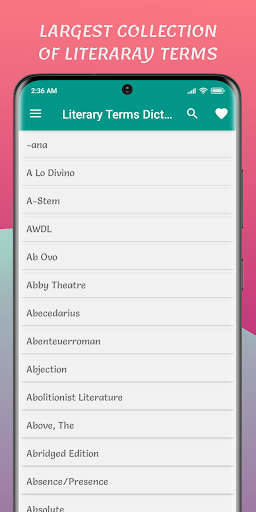
Master literary analysis with Literary Terms Dictionary, your comprehensive offline reference for understanding poetic devices, narrative techniques, rhetorical strategies, and critical terminology essential for analyzing literature across all genres and periods.
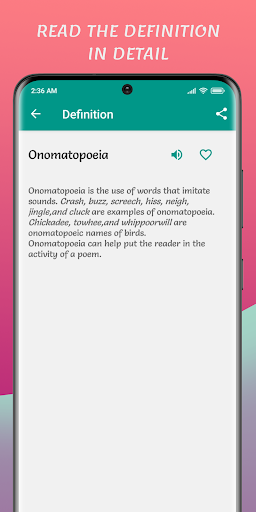
This educational application provides clear, accessible definitions for hundreds of literary terms from basic concepts like metaphor and simile to advanced critical theory vocabulary. Each entry explains not only what the term means but also how it functions within literary works, supported by relevant examples from canonical texts.
📖 Comprehensive Coverage
Poetic Devices:
Figures of speech including metaphor, simile, personification, hyperbole, and alliteration. Understanding sound devices like assonance, consonance, and onomatopoeia. Structural elements including meter, rhyme scheme, and stanza forms.
Narrative Techniques:
Point of view variations, narrative perspective, stream of consciousness, flashback, foreshadowing, and frame narrative. Character development methods and plot structure components.
Rhetorical Devices:
Persuasive techniques including ethos, pathos, logos, anaphora, and chiasmus. Understanding argument construction and persuasive writing strategies.
Literary Movements:
Romanticism, Realism, Modernism, Postmodernism, and other major literary periods. Understanding historical context and characteristic features of each movement.
Critical Theory:
Introduction to formalism, structuralism, post-structuralism, feminist criticism, Marxist criticism, and other analytical frameworks used in literary scholarship.
Genre Terminology:
Specific vocabulary for analyzing poetry, drama, fiction, and non-fiction. Understanding genre conventions and classification systems.
📚 Educational Features
Complete literary terminology database
Clear definitions with contextual examples
Cross-references between related terms
Search functionality across all entries
Bookmark important concepts
Completely offline access
Regular updates incorporating contemporary usage
Free comprehensive access
🎓 Ideal For
Literature students at secondary and university levels, educators teaching language arts and literature, writers developing craft knowledge, book club participants seeking deeper analytical tools, and general readers wanting to enhance literary appreciation.
💡 Sample Definitions
Imagery: Descriptive language appealing to sensory experience, creating vivid mental pictures through visual, auditory, tactile, olfactory, or gustatory details.
Irony: Contrast between expectation and reality, existing in verbal form (saying opposite of literal meaning), situational form (outcomes contrary to expectations), or dramatic form (audience knows information characters don't).
Symbolism: Use of concrete objects, actions, or characters to represent abstract ideas or concepts, adding layers of meaning beyond literal interpretation.
⚡ Download Now
Enhance literary analysis capabilities with Literary Terms Dictionary. This free resource provides essential vocabulary for understanding and discussing literature effectively.
"Literature is the art of discovering something extraordinary about ordinary people." - Boris Pasternak
Disclaimer: Definitions based on established literary scholarship and regularly updated to reflect current critical usage.
Updated
2026-01-20
Version
2.5
Developer
Elyte Labs